Search list pages
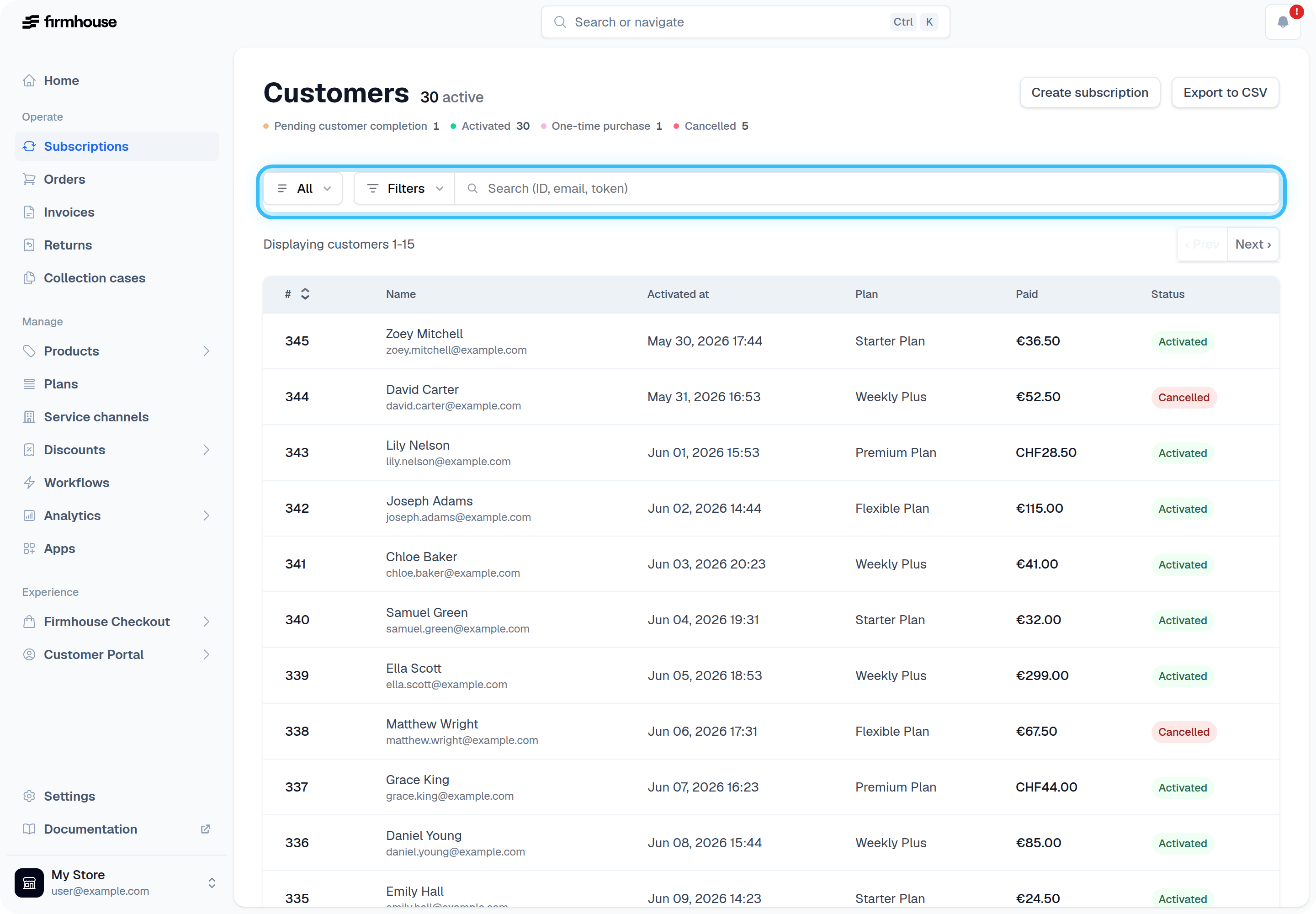
Most list pages in Firmhouse include a search field near the top of the page. Enter your search term and Firmhouse updates the list to show matching records. Clear the search field when you want to return to the full list. Search is useful when you want to find a specific record quickly:- Subscriptions: search by customer name, company name, email address, customer reference, subscription ID, or subscription token.
- Orders: search by order ID, subscription ID, track and trace code, or customer details from the related subscription.
- Invoices: search by invoice ID, invoice number, subscription ID, or customer details from the related subscription.
- Accounts: search for a subscription account when your project uses subscription accounts.
- Products: search the product list when you need to find a specific product.
- Collection cases: search collection cases when you need to find a specific customer, invoice, or case reference.
Where to use filters
Subscriptions, orders, invoices, products, and collection cases use a shared filter bar with saved views:- Subscriptions: filter by status, plan, product, billing status, customer details, payment method, payment failures, unavailable products, activation date, cancellation date, next billing date, and subscriptions with no upcoming shipment.
- Orders: filter by status, shipment date, order creation date, total costs, and Shopify order status when your project is connected to Shopify.
- Invoices: filter by status, invoice date, amount, pending retry, and overdue status.
- Products: filter by order availability, customer portal availability, order schedule when supported by your project, and collection when product collections are enabled.
- Collection cases: filter by subscription ID, status, and creation date.
Apply filters
Open the relevant list page and click Filters to narrow the list by structured criteria.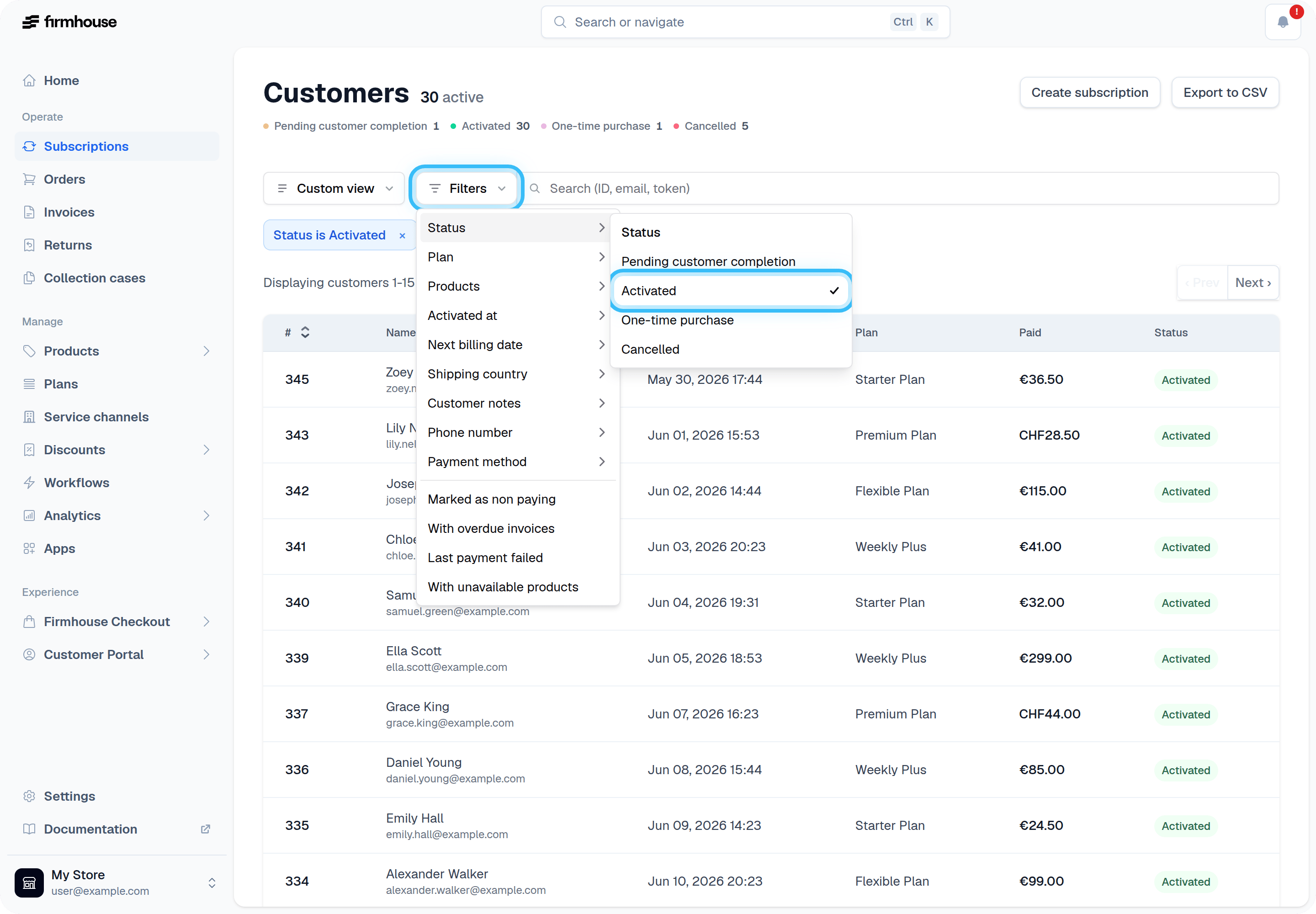
- Click Filters.
- Select the filter you want to use.
- Choose one or more values, enter a date range, or enter an amount range.
- Repeat this for any other filters you need.
Filter subscriptions
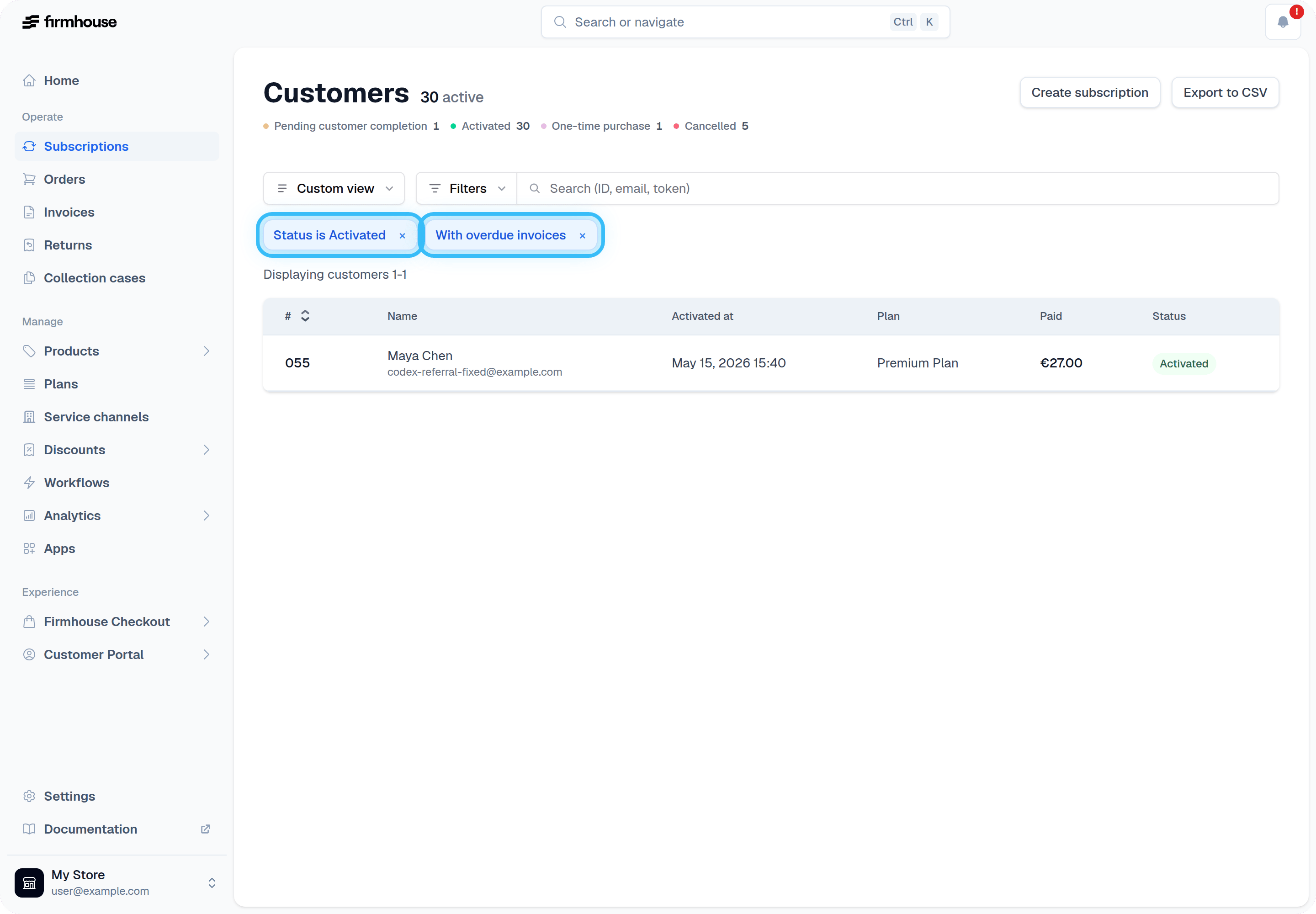
The Subscriptions page is useful for finding customers by lifecycle status, product, plan, billing problem, or customer detail. Common examples:- Use Status to find activated, paused, cancelled, or other subscription states.
- Use Products to find subscriptions that include one or more products.
- Use Marked as non paying, With overdue invoices, or Last payment failed to find customers that may need follow-up.
- Combine Marked as non paying with Sent to collections to separate customers whose invoices are already in a collection case from those that are not.
- Use Missing future shipment date to find active subscriptions that do not have another shipment scheduled.
- Use Activated at, Cancelled at, or Next billing date to work with a specific time period.
- Use Customer notes or Phone number when you need to search details that are not part of the main search field.
Check subscriptions with no upcoming shipment
An active subscription can sometimes be left without an upcoming shipment after an order or billing problem. The customer still appears active, but no future order is scheduled. Without a review, the problem may only become visible when the customer notices that an expected delivery did not arrive. Use the Missing future shipment date filter as an operational check to catch these subscriptions earlier:- Open the Subscriptions page.
- Click Filters, then select Missing future shipment date.
- Open each matching subscription and review its active products, recent orders, and payment history to understand why its schedule stopped.
- Resolve the underlying problem first, then set the appropriate next shipment date when needed.
Filter orders
The Orders page helps you find orders by fulfillment state, date, amount, and Shopify creation state. Common examples:- Use Status to focus on pending, confirmed, cancelled, or fulfilled orders.
- Use Shipment date when preparing work for a specific delivery window.
- Use Order created to find orders created during a specific period.
- Use Total costs to find orders in a certain amount range and currency.
- Use Shopify order to find orders with or without a created Shopify order. This filter appears only when it applies to your project.
Filter invoices
The Invoices page helps finance and support teams find invoices by payment state, date, amount, retries, and overdue status. Common examples:- Use Status to focus on paid, unpaid, failed, credited, or other invoice states.
- Use Invoiced at to find invoices from a specific period.
- Use Amount to find invoices in a certain amount range and currency.
- Use Pending retry to find invoices where Firmhouse is waiting for a retry attempt.
- Use Overdue to find invoices that need follow-up.
Filter products
The Products page helps you review catalog setup and find products by availability or collection. Common examples:- Use Available to order to find products that customers can or cannot order.
- Use Available in customer portal to review which products customers can select in the portal.
- Use Order schedule to find products that ship every billing cycle, only once, or on a custom schedule. This filter appears only when it applies to your project.
- Use Collection to find products in a specific collection. When your project uses Shopify product collections for the portal, you can also find products that are not in any collection.
Filter collection cases
The Collection Cases page helps finance and support teams review debt collection follow-up. Common examples:- Use Subscription ID to review only the collection cases for one subscription. The link from an open collection case warning on a subscription applies this filter automatically.
- Use Status to focus on open or closed collection cases.
- Use Created at to find collection cases opened during a specific period.
Use predefined views
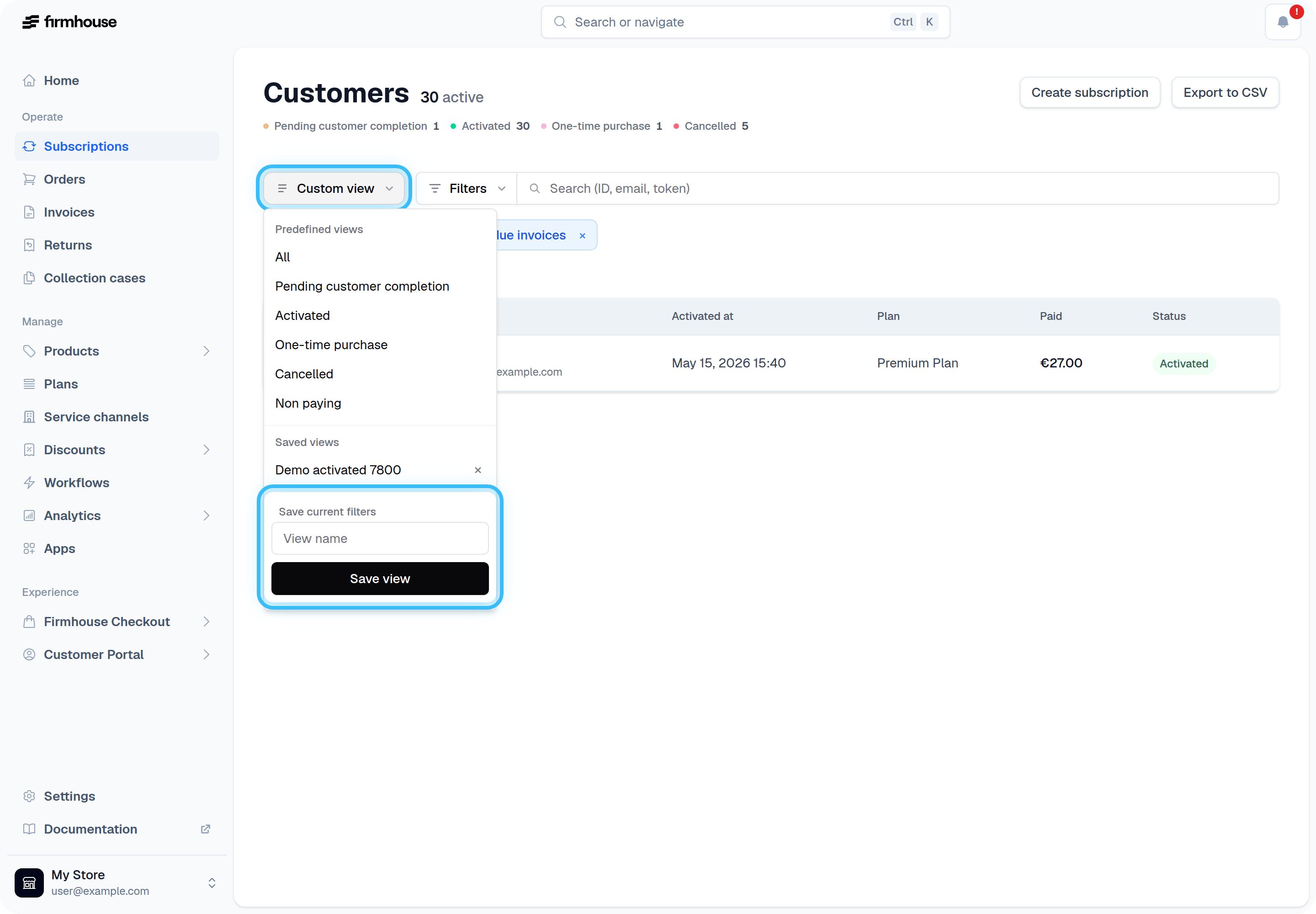
The view selector next to the filter bar contains predefined views for each list. These are built-in shortcuts such as All, status-based views, and other common list states. Selecting a predefined view updates the list immediately. You can still add extra filters after selecting a predefined view. When the current filters no longer match one of the built-in views, the selector shows Custom view.Save your own views
Saved views store the current filters for the current list page. Subscriptions, orders, invoices, products, and collection cases each have their own saved views. To save a view:- Apply the filters you want to reuse.
- Open the view selector next to the filter bar.
- Enter a name under Save current filters.
- Click Save view.